“I Either Had to Do Something About It, or Let It Disappear”

Updated: Aug 27


Sophie Clement is a nurse, a long-time performer, and - as of this year - a director. Her debut full production was a bold, multimedia staging of 1984 with Leeds Arts Centre: morph-suited figments, iPads as telescreens, a lighting cue timed to a climax, and a studio layout she fought hard to get. Kate Maddison-Greenwell and Paula Boyle sat down with her to find out how it all came together.
TLDR: A first-time director, a year of her life, and a show that came together because she refused to let the idea go. Sophie Clement talks about the figments concept that had to come first, standing her ground against five people who said the bed in act two was a stupid idea, teaching herself Audacity in a week when the sound designer ghosted her, and why she always had a backup plan for the intimate scene. Plus: her advice for any actor thinking about directing but not quite sure they’re ready.
First of all - congratulations. How do you feel now it’s all over?
Honestly, I’m just so proud of everyone. I could not have asked for a more dedicated or passionate cast and crew. Everyone rallied round and said, this is something that matters, and it just became infectious. If they’re putting that much in, I can put that much in. And the most important thing to me was that everyone enjoyed themselves. I wanted to make a good piece of theatre, but everyone had to enjoy the process too. I’m so proud that we achieved that as a group. And yeah - I’m tired. It’s been basically a year of my life.

What made you want to step into directing? Was it always something you wanted to do?
Honestly, directing was never something I necessarily wanted to do until 1984. That was the thing that made me want to do it. So it was the play first.
I’d been acting for a very long time, and there are moments, when you’ve done it a while, where you think - that’s not a choice I would have made, but you go with it. This was the first time I had the ideas myself. Life happened, as it does, and I started re-reading the book. And there was one moment - a scene where Winston imagines himself walking over to Julia in a crowd - and the way my brain visualised it was something very similar to what I ended up with: the figments*. A figure walking forward. I thought, how would you do the rest of it?
The more I thought about it, the more came. I found a few scripts and I absolutely hated the majority of them. Then I found one that worked with the idea of memory and identity, and it just got into my head. It became a point where I realised I either needed to do something about these ideas that wouldn’t leave me alone, or let them disappear. And I didn’t want to let them disappear.
I wanted to make a statement about where the world is going. I didn’t want to just be someone who moans about it and lets it continue anyway. If I can make one person think about what we’re letting slide - our civil liberties, who votes, who pays attention - then it’s worthwhile. And we’re talking on election day, so, fortuitous timing!
*Figments - four performers dressed head to toe in dark morph suits, faces completely invisible, playing the internal reactions of the lead character. Whatever Winston can’t show on the outside - the shock, the longing, the fear - the figments show for him.
Was the figment idea something that came to you as you were planning, or did it develop more naturally as you went?
That was one of the very first ideas I had. Because I find the idea of doing 1984 disingenuous if you don’t find a way of showing the inner world. The most important part of the story is that it’s all told from Winston’s point of view - you feel what he feels. He can’t show any of that. If you allow your actors to express what he’s thinking through their faces, you’re losing what makes the book important. You’re losing the fear.

So I needed to find a way of showing that emotion without having the lead show it - which is terrifying for him. He’s a phenomenally expressive actor, very Stanislavski in the way he builds characters, and I was asking him not to show what he was feeling. Getting him to trust that the other four actors would carry that for him was a real process.
And the figments themselves - all very talented actors - couldn’t speak. They couldn’t use their faces, which are the most important tools actors have. They effectively were five people playing the same role and trusting each other to do the bit the others couldn’t.
There’s also something deeper in it. When you think back to a memory, you don’t always see faces. You see the shape of a person. A gap. The figments were filling in those gaps - parts of your brain that know something was there, but can’t quite remember what.
You were a first-time director on quite an ambitious production. Were there moments of imposter syndrome? How did you push through?
Quite a few moments. People were telling me I should be doing it on the main stage. But I wanted the studio. I wanted it to feel immersive and oppressive, like the audience was part of it. You can’t get that on a big stage - you’re watching theatre rather than being inside it. Even the projection - on a big stage it would have been a tiny thing at the back. You needed it to be oppressive for everyone.
The way I tend to work is I set myself rules. Things this production needs in order to function. For example: if a telescreen is present, the lead can’t show emotion on their face - they would have been arrested. That’s not a creative choice, that’s the logic of the world. The blocks always faced black in the first act, white in the second. If those rules break, something breaks later on.

There were times I had to stand my ground. I pushed hard for a new studio layout with a centre aisle so I could have different entrances and exits. Five separate people told me the bed in the second act was a stupid idea, a pain to get in, and I didn’t know what I was doing. I knew that without it the sight lines wouldn’t work and my actor would have hurt his back. Raising it made it so much more impactful.
The hard part, especially as a new director, was knowing where to stand firm and where it mattered - and sometimes saying, you’ve got more experience than me, let’s try it your way. If it doesn’t work, we go back to my plan. I’m not ego-driven. If an actor comes to me with an idea and there’s no reason it can’t work, I’m a hundred percent going with it. I want people to feel collaborative. And because I was giving them that, they started to trust me when I stood my ground.
Did that trust hold? Did you come up against real conflict?
Actually, no. They trusted very quickly. I’d done quite a bit of acting with Leeds Arts Centre before, so there was goodwill already. And the collaborative nature of it meant we didn’t compromise - not on a single thing. There were challenges. I was meant to have an assistant director who dropped out after week three. We didn’t follow a single stage direction in the script, because the script calls for three thousand bluebells to fall from the ceiling and the stage to lift up. So you adapt.
I remember the stepping stone scene being the hardest to get people to trust. Winston and Julia have to meet in a crowd - they’re hidden by the numbers of people around them. But if everyone’s on the flat, you lose the leads entirely. So I had the figments use the blocks to create raised paths just for Winston and Julia, so they were moving above the crowd, still part of it but visible. We spent two hours blocking it completely differently first, and I went home knowing it hadn’t worked. Next rehearsal: I know we spent two hours on this, but I want to try something else. Winston and Julia got it instantly. The figments nearly had a breakdown because they needed to know exactly where every block went on every line - and this scene doesn’t work like that. It’s fluid. You have to trust it.
It was quite multimedia - projection, tablets, lighting design. Did you have a clear vision for all of that from the start, or did it evolve with the team?
All the ideas came from me. Ben Hopwood, my production manager, was deliberately hands-off with the creative side - he wanted to give me the opportunity to bring my vision. But I never go to people with ideas I don’t know how to execute. I don’t like saying ‘I want to do this’ if I haven’t worked out whether it’s actually possible.

The iPad idea - I tested it first. I found a few iPads, worked out a way of projecting a PowerPoint through Discord, confirmed the concept worked for three, knew we could scale it. The telescreen in 1984 is a device that records and transmits simultaneously. That’s basically a phone or an iPad. If Orwell could write about it seventy-six years ago, I can put it on a stage today and show that it’s terrifyingly modern.
The blocks - I planned how many we needed, how much wood, what it would cost. I went to Ben and the set team with the plans. Lighting was the first thing we designed, before any staging at all. I brought in a friend, Nicole, who’d done it professionally for touring shows, and paired her with Dan, one of the LAC members who’d been wanting to learn. Dan ran the tech on the night. Nicole taught him. I like putting people together so they can grow.
And then the sound - the student who was supposed to design it ghosted me three weeks before. So I taught myself Audacity in a week. Voice recordings, songs cut down from four verses to one, soundscapes built from scratch. I did most of it myself in a few days because it needed to happen and there was no one else. I will never ask anyone to do something I don’t know is possible. The exception was the film projections - Marlowe did those, and he was phenomenal.
How did you make the whole cast and crew feel included and supported - was that something that evolved or were there deliberate structures?
Both. I’m a big believer in making sure everyone feels respected for what they do. You get a backstage versus on-stage mentality in a lot of shows, and I didn’t want that. So from the very beginning, Ben and I planned socials that were clearly for cast and crew together - we went bowling, things like that, with teams deliberately mixed between backstage and on-stage. So by the time tech week came, everyone already knew each other. No one was being a diva on stage because they knew it was messing up the tech team, and the relevant member of the tech team may only be available on one day. Everyone wanted to support each other.
I was also deliberate about casting in terms of personalities. The figments needed to obsess together and egg each other on - if you put two people who are really into it with two who aren’t quite sure, it won’t work. So I chose people I knew would stress each other out in the best possible way.
And it all starts at the top. I chose Ben as production manager because he’s calm and collected - when he’s stressed, he doesn’t lash out. If you lead with that ‘it’s okay, we can fix this, it’ll be alright’ energy, it filters down. It keeps the stress levels manageable and makes everyone feel like they’re still in control.
The production has an intimate scene between Winston and Julia. How did you handle that?
I brought in Aimee Cross, a professional intimacy coordinator - she’s based in Liverpool and drove up, and also covered the fight choreography, so she did double duty for us. We’d worked with her before on A Midsummer Night’s Dream. She ran closed sessions with me, Sophie, and Connor, with a third person always present so the actors had someone to go to who wasn’t me.
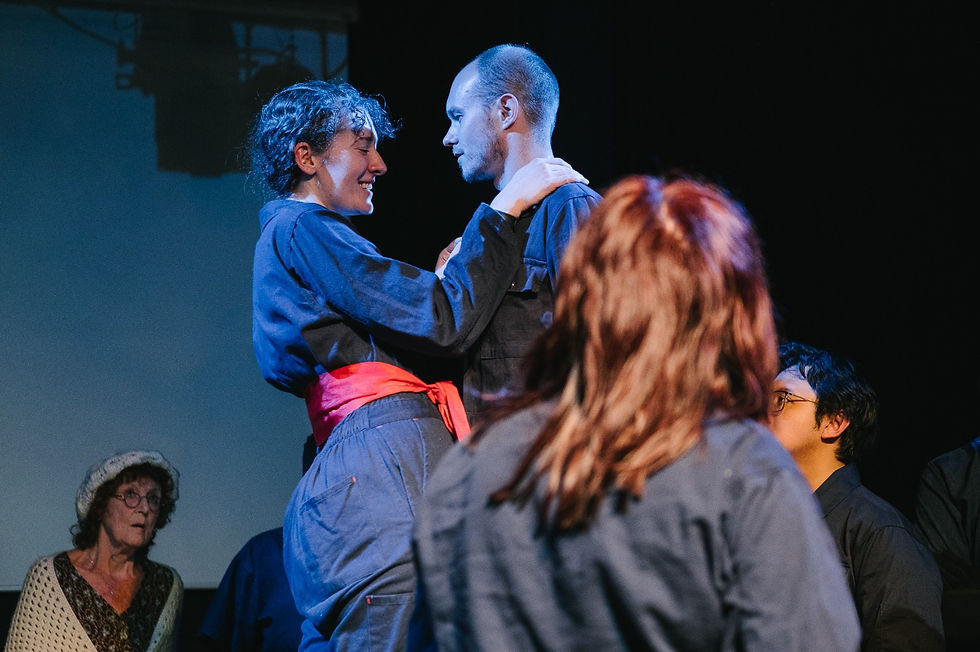
Nothing was left to improvisation. Every movement was choreographed and talked through. Aimee’s approach is that laughter is allowed - welcomed, even - because sex is awkward in real life, and pretending it isn’t just makes people feel self-conscious and less likely to say when something isn’t working. As long as you’re not laughing at each other, it releases the tension and keeps the communication open.
There was always a physical barrier in place during blocking. And I was very clear from the start: I do not and would not expect anyone to get naked for community theatre. It’s not needed. More than that - I told both of them that if on any night they couldn’t do the scene, for whatever reason, come to me. I always had a backup plan in my head. Their safety and their comfort is more important than accuracy to the book. Knowing that gave them the confidence that they weren’t letting me down.
Sophie’s favourite note from the rehearsal room: “Sophie, Connor - your climax is a sound-and-lighting cue. It needs to be loud enough that if the tech team aren’t blushing at the back, it won’t land.”
Looking back now - is there anything you’d do differently?
Honestly, I’m amazed at how close to my vision it came. I had three levels when I was planning it - this is the dream, this is what I expect, this is what I’d settle for. I hit the top level for the majority of it. People kept coming to me with things that were better than what I’d planned. The rat box was better because one of my cast is an electrical engineer and just offered to build it.
The one thing I’d do differently: time management on the script. Three weeks before, the first act was running an hour and forty minutes. It was meant to be an hour. Part of that was scenes overlapping - the style of the piece requires them to run into each other, but people were hesitating. And the movement pieces added more time than I’d accounted for. In future, I’d be more rigorous about having sound in place earlier too. Having placeholder tracks when the student dropped out was really stressful. Those are logistics I’d lock down sooner.
For someone who acts but has never directed and is thinking about it - what steps would you suggest to build the confidence to try?
Join a community theatre group, first of all. For me, Leeds Arts Centre has been phenomenal - the support you get if you’ve never done anything before is fantastic. I wouldn’t have felt comfortable going into directing without doing backstage roles first. I production managed, I stage handed, I talked to the tech team. You pick up how to stage things as an actor over time, but understanding what you’re actually asking for when you make requests of people - that comes from doing those jobs yourself.
When you’ve personally been asked to source three hundred identical cups, you know exactly what it means to make that ask of someone else. And that empathy makes you a better director. It makes you more creative, because you’re not asking for the impossible.
I also assistant directed on a play before I directed my own. At Leeds Arts Centre, you have to direct a Green Room production before you can direct a main stage show - a smaller piece, minimal tech, a few actors. That got me into writing up sheets, blocking, the basics. So: get involved in other roles, assist on something, and find a group where you’ve got support and a mentor. Do by doing.
What’s next for you? More directing?
I miss acting, honestly. This has been a year of directing and I love it, but acting is where my passion lives - I disappear into a character and it’s a lot less stressful. That said, I have an idea for a mainstage show at Leeds Arts Centre in a few years. I want to put together some workshops - getting experienced people in to teach lighting, sound, directing, movement - and run them at arts centres to give people a taste of what’s out there. So, a bit of everything really.
Last one - how do you balance all of this with your day job as a nurse?
I took annual leave. I knew this would be intense, so for the last couple of months I took one day a week as annual leave. I worked three ten-hour days and had four-day weekends for play prep. And I made sure one of those days was completely off - not work, not theatre. Just me. I didn’t always answer emails, but I wasn’t actively thinking about rehearsals or sound plots. You stop yourself becoming overwhelmed that way. And I had a phenomenal production manager who made sure we both looked after ourselves.

Sophie is exactly the kind of person Rise & Howl exists to champion. She had an idea she couldn’t shake, and instead of waiting for permission, she got in the room and made it happen. We’re proud to know her, and we’ll be watching what she does next.
You can find out more about Leeds Arts Centre here.
Rise & Howl Collective is a Yorkshire-based theatre production company founded by actors Kate Maddison-Greenwell and Paula Boyle. Our next production is The Shroud Maker by Ahmed Masoud, directed by Julie Domaille - a one-woman black comedy about an 80-year-old Palestinian woman who makes shrouds for the dead. 25 July 2026, Seven Arts, Leeds and 31 July 2026 in Hebden Bridge Little Theatre.
Tickets at www.riseandhowl.co.uk.


Comments