Growing Bindweed

How two producers turned a brilliant challenging script into their first touring production

Making independent theatre is rarely as simple as putting on a show. For Rise & Howl’s production of Bindweed, the journey involved script discoveries, workshops, difficult conversations in rehearsal rooms, learning how to market a show on social media from scratch, and even producing across different cities while one of the producers was abroad. Along the way there were lessons about collaboration, communication, and holding space for challenging material. In this behind-the-scenes conversation, co-founders Kate Maddison-Greenwell and Paula Boyle share how Bindweed came to life, what they learned along the way, and why the conversations sparked by the play made the whole journey worthwhile.
Independent theatre can look seamless once the lights go up. Audiences see the performances, the set, the story unfolding on stage. What they rarely see is the complicated journey behind it: scripts debated over coffee, rehearsal rooms borrowed where possible, difficult conversations in rehearsal rooms, and the constant balancing act of producing a show while still trying to sell tickets.
For Rise & Howl Collective, Bindweed became exactly that kind of journey. Kate and Paula set out to produce a play that would spark conversation. What followed was a process filled with creative discovery, logistical challenges and a steep learning curve in the realities of independent producing.
Here Kate and Paula discuss the process, in the hope that their lessons learned may be shared by others.
Step one: Finding a play that is important to you and knowing why.
“We knew we wanted to produce something meaningful,” Paula states, “but also entertaining, because really that’s what Rise & Howl is about. We’d been hunting for the right script for a while and when Paul Chewins (our wonderful director) announced, 'I’ve found this play…' well I read it and loved it and it stuck."
When she passed the script to Kate, the reaction was similar.
“I had that feeling that it had lodged itself somewhere in my stomach,” Kate says. “It wasn’t comfortable reading, but it was compelling. We started talking about whether it was the right kind of piece for Rise & Howl.”
Paula admits, “for me there was a personal draw, my work has exposed me to the challenges of facing and discussing domestic abuse and having interacted with several local charities in this field I knew I wanted to do something to support this dialogue.”
The timing turned out to be striking. Not long after they began developing the project, Louis Theroux: The Manosphere aired, prompting widespread public discussion about masculinity and online culture.
“I did feel like something was in the zeitgeist,” Kate says. “We had already started exploring the play, and suddenly there were national conversations happening about similar themes. We then knew, this wasn’t just an interesting piece of theatre. It was part of a much wider conversation.”
Step two: Gather the right team
Any project needs the right team. Through our own work locally we had interacted with many creatives and knew for such an exploratory project we’d need a director and a stage manager with specific skills. As Paula states... “Yeah, the job specs would have been a little daunting…
💡"Can you plan staging, lighting and music that is simple enough to take to multiple venues without losing impact?
👥Can you interact with a new venue and technician in the four hours before a performance?
📍Can you rehearse anywhere and everywhere?
💸Can you do all this on a tiny budget?
🎭Oh and yeah… can you be in it?”

It’s not just about the practicalities though, as Kate explains, “With difficult material, you need a director who can hold the room and create a thoughtful process,” she says. “Paul brought that balance of clarity and care.”
Step three: Get to know the material and shape your vision
Rather than jumping straight into auditions, the producers decided to start with a workshop.
“The first step was simply to explore the play,” Kate explains. “We invited actors into a workshop where we could run through scenes, see how people responded to the material and observe the chemistry between actors.”
Paula says this stage was crucial. “It allowed us to understand how the play worked in the room. We could see how actors connected with the subject matter and whether the tone felt right.”

After the workshop, they invited actors to audition for the production. “That process helped us make much more informed casting decisions,” Paula says. “It wasn’t just about performance, it was about how people approached the themes and whether they matched Paul’s vision."
Casting a play like Bindweed required more than simply finding talented performers.
“We were looking for actors who could work as an ensemble,” Kate says. “The play asks a lot emotionally, so trust between the cast becomes really important.”
Paula observes, “the additional challenge of a tour meant we were also looking for people who were flexible, honest in communicating their needs and willing to stack chairs into and out of cars; it’s real team effort. You also need to know they will be unfazed by the unpredictability of turning up, setting up and performing in a venue they’ve never seen before. That level of flexibility and resilience are skills in themselves.”
Step four: Find your rehearsal space
Rise & Howl prides itself on a collective, collaborative approach. Practically this means fitting in around everyone’s schedules, as Paula observes, “you are so acutely aware that everyone is giving up their free time and often have other projects on the go and fitting it in can be a challenge, again it comes down to flexibility, communication and understanding.”
Then you have the added challenge of finding rehearsal space, “Securing rehearsal space is genuinely one of the hardest parts of making independent theatre,” Kate says. “You spend so much time simply trying to find somewhere affordable and available.”

The company were grateful for the opportunity to rehearse at Fox & Newt, Ilkley Golf Club, Bingley Amateur Operatic Society and Bingley Little Theatre whose space allowed the team to continue their work and keep ticket prices affordable.
“That kind of generosity makes a huge difference,” Kate says. “Without it, many productions would simply never get off the ground.”
But working across multiple spaces required flexibility. “Different rooms, different layouts, different kettles,” Paula explains. “It forces you to be inventive.”
✨Top Tip: Be flexible and inventive and grateful for time and space. Who do you know?
Step Five: Create a safe space for play
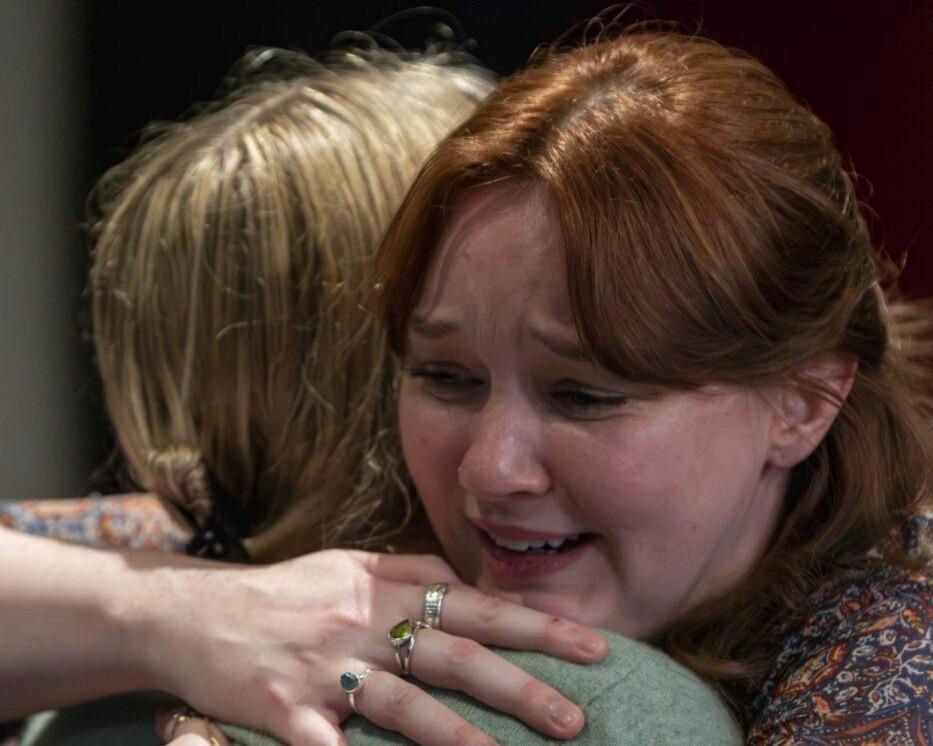
Because the themes of Bindweed can be emotionally difficult, both producers were conscious of the need to support the cast during rehearsals.
“We tried to create an environment where people could speak openly,” Paula says. “It helped that we all knew each other as everyone had a unique take on the material. At times it was really hard, but I look back now and realise it was a privilege to work on material that makes you care so much about what you are trying to say.“
Kate believes those conversations were essential.
“Creating a safe space isn’t something you do once and move on from,” she says. “It’s something you have to keep working at.”
Both producers acknowledge that there were lessons along the way.
“There were moments where we realised we could have done things differently,” Kate says. “Those experiences have shaped how we’ll approach similar work in the future.”
Step six: Decide on role division and communication methods
As if producing a show wasn’t complicated enough, part of the process took place while Kate was abroad for five weeks.
“That definitely added another layer,” she says. “A lot of coordination happened remotely.”
During that time, Paula carried much of the practical responsibility. “There were plenty of calls and messages,” Paula says. “But it also meant trusting each other to make decisions when needed.”
Location also presented logistical hurdles. Kate is based in Leeds, while several venues for the show were in Bradford. “That creates a surprising amount of coordination,” Kate explains. “Travel, scheduling, meeting venues. It’s part of the reality of producing theatre across different cities.”
Step seven: Learning how to sell a show
Perhaps the steepest learning curve came in marketing the production. As Paula says, “we tried every method we could think of: Press call-outs, radio shows, posters, flyers, engaging with local communities, charities and organisations and of course social media. I am a self admitted luddite so Kate’s social media skills were called on and escalated to which I am infinitely grateful. I think at one point she was editing videos whilst on a train somewhere in Asia.”
“Social media was a real learning experience,” Kate admits. “We had to learn how to edit videos, come up with content ideas, post consistently and try to get potential ticket buyers to engage.”
Paula agrees that attracting attention online is harder than it looks. “Trying to stop someone scrolling long enough to care about your show is a challenge,” she says.
But the team gradually improved. “We experimented, learned and got better,” Kate says. “By the end of the run we were much more confident about what worked.”
“Our last two shows sold out, something we are really proud of” says Paula.
✨Top Tip: Brainstorm every avenue of marketing, consolidate your message and be resilient and creative.
Step eight: Putting on the show
Paula states, “this is a complicated beast of numerous conversations with venues and technicians and being prepared for every eventuality on the day. We learnt not to make any assumptions and had a plan for each venue both before the day and on it. You never quite know what you are going to get and to be honest, that’s part of the joy. Ultimately on the day as long as everyone was healthy and we could keep Julie (our amazing stage manager) and Paul happy we were sure the rest would muddle out. This is another reason your team really matters, everyone wears lots of hats: someone sticks tape to a floor, someone else goes flyering, someone’s up a ladder sorting lights, another's hanging curtains whilst someone else is doing a behind the scenes video.”
The actual show itself sometimes feels like the easy bit.
✨Top tip: Have a plan for each venue and communicate.
The conversations that mattered
For both producers, the most rewarding moments came after the curtain call.
“When audiences stay behind to talk about what they’ve just seen, that’s when you know the play has landed,” Kate says.
Paula agrees. “The text that says, 'I’ve been thinking about the play all weekend' or the email from a domestic abuse charity to say, 'thank you, everyone should see this piece of theatre.' That’s when you know you have sparked something by getting people to talk and in doing so increase empathy and understanding. Frankly, that’s enough for me."

Step nine: Observe and reflect
Looking back, the journey of Bindweed reinforced something both producers already believed.
“We started Rise & Howl because we wanted to create theatre that matters,” Kate says.
Paula nods. “The process can be messy and difficult,” she says. “But when audiences connect with a story and start conversations because of it, that makes every challenge worthwhile."


Comments